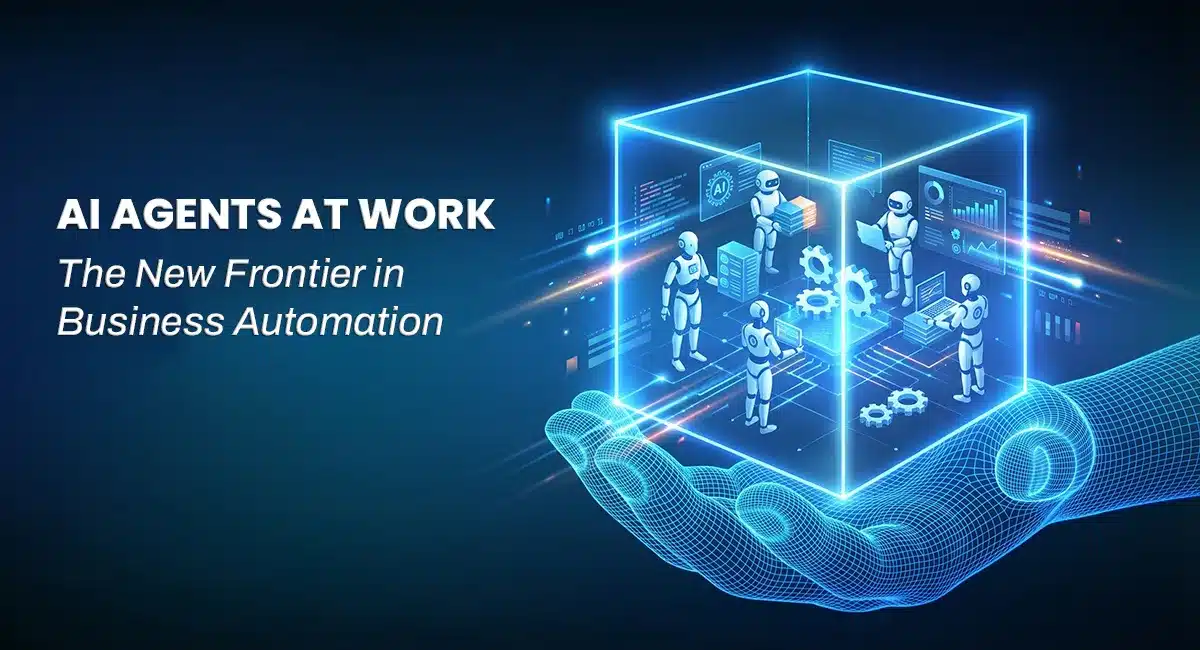
The workplace is undergoing a seismic shift. For decades, automation meant rules-based systems software that followed rigid “if-this-then-that” instructions. But a new frontier has emerged: AI agents at work.
With traditional automation, AI agents don’t just follow commands. They reason, plan, remember, and act autonomously. They are the digital workforce that never sleeps, scales instantly, and adapts to changing conditions. As organizations seek AI solutions for enterprises, understanding this technology is no longer optional, it’s a competitive imperative.
Gartner predicts in the near future, AI agents will make 15% of everyday workplace decisions, up from virtually zero in the past. This transformation represents one of the most significant shifts in business operations since the cloud revolution.
This blog explores what enterprise AI agents are, the types available, the distinction between AI agents and agentic AI, and how these systems are transforming business operations.
What Are AI Agents for Enterprises?
An enterprise AI agent is an autonomous software system designed to achieve specific goals within a business environment. Traditional chatbots that respond to direct prompts, AI agents operate with a degree of independence.
Core Characteristics of Enterprise AI Agents
| Characteristic | Description |
| Autonomy | Operates without constant human intervention |
| Reasoning | Breaks down complex goals into actionable steps |
| Memory | Retains context across sessions and tasks |
| Tool Use | Interacts with APIs, databases, and software applications |
| Goal-Oriented | Focuses on achieving specified outcomes, not just responding |
| Adaptability | Learns from feedback and adjusts behavior over time |
How Enterprise AI Agents Work
At their core, enterprise AI agents follow a continuous loop:
- Perceive – Gather data from user inputs, system events, or environmental changes
- Reason – Analyze the situation using LLMs and decision frameworks
- Plan – Determine the optimal sequence of actions
- Act – Execute tasks via APIs, tool calls, or system commands
- Learn – Incorporate feedback to improve future performance
This loop enables agents to handle complex, multi-step workflows that would previously require human oversight.
Types of AI Agents
Not all AI agents are created equal. Different architectures suit different use cases. Here are the primary types of AI agents deployed in enterprise environments.
1. Simple Reflex Agents
These agents respond directly to current perceptions without considering history. They operate on condition-action rules.
Example: A support ticket router that assigns incoming tickets based on keyword matching
Best For: Straightforward, stateless tasks with clear rules
2. Model-Based Reflex Agents
These agents maintain an internal model of the world, allowing them to handle partially observable environments.
Example: A customer service agent that remembers conversation history within a session
Best For: Multi-turn conversations, context-dependent responses
3. Goal-Based Agents
These agents evaluate possible actions based on whether they achieve a specified goal. They consider “what if” scenarios.
Example: A sales agent that qualifies leads by asking questions until enough data is gathered
Best For: Tasks requiring exploration and information gathering
4. Utility-Based Agents
These agents choose actions that maximize a utility function—measuring “how good” an outcome is, not just “whether” it achieves the goal.
Example: A pricing agent that balances profit margin against conversion probability
Best For: Optimization problems with trade-offs
5. Learning Agents
These agents improve over time by observing feedback and outcomes from their actions.
Example: A recommendation agent that refines suggestions based on user clicks and purchases
Best For: Personalization, continuous improvement scenarios
6. Multi-Agent Systems
Multiple specialized agents collaborate, delegate, and coordinate to solve problems beyond any single agent’s capability.
Example: A research agent gathering data, a drafting agent creating reports, and a compliance agent checking regulations
Best For: Complex, end-to-end business processes
AI Agents and Agentic AI
The terms “AI agents” and “agentic AI” are often used interchangeably, but they represent different concepts within the same family.
AI Agents (General Definition)
An AI agent is any autonomous system that perceives its environment and takes actions to achieve goals. This broad category includes everything from simple reflex agents to sophisticated learning systems.
Key characteristics:
- Task-focused
- Often single-purpose or limited-domain
- Operates within defined boundaries
Agentic AI
Agentic AI refers to a more advanced paradigm where AI systems exhibit higher degrees of autonomy, reasoning, and adaptability. Agentic AI systems are designed to handle complex, open-ended tasks with minimal human guidance.
Key characteristics:
- Goal-oriented rather than task-oriented
- Capable of planning multi-step sequences
- Adapts strategies when conditions change
- Often combines multiple agent types
The Evolution
| Era | Capability | Example |
| Rule-Based Automation | Follows fixed instructions | Email auto-responder |
| AI Assistants (Copilots) | Suggests actions, requires human approval | Code completion tools |
| AI Agents | Executes tasks autonomously within scope | Lead qualification bot |
| Agentic AI | Reasons, plans, and adapts across domains | Autonomous procurement system |
Key Differences Between AI Agents and Agentic AI
Understanding the distinction is crucial for enterprise leaders evaluating AI solutions for enterprises.
| Dimension | AI Agents | Agentic AI |
| Scope | Narrow, task-specific | Broad, goal-oriented |
| Planning Horizon | Short-term, immediate actions | Long-term, multi-step sequences |
| Adaptability | Limited to predefined parameters | Learns and adjusts strategies |
| Tool Use | Uses specific, pre-configured tools | Discovers and learns to use new tools |
| Human Oversight | Regular checkpoints required | Operates with minimal intervention |
| Complexity Handling | Handles routine, predictable tasks | Manages ambiguous, changing conditions |
| Decision Framework | Follows rules or simple utility | Balances multiple objectives dynamically |
| Memory | Session-based or task-specific | Long-term, cross-task memory |
Practical Example
AI Agent: A customer support agent that handles refund requests. It follows a defined workflow to verify purchase, check return window, process refund, and send confirmation.
Agentic AI: A customer experience system that monitors support tickets, identifies recurring issues, proposes product improvements, schedules follow-ups, and adjusts refund policies based on outcomes, all without separate human prompts.
How AI Agents Are Transforming Business Operations
The adoption of advanced AI technology is reshaping every business function. Here’s how AI for business intelligence and automation are driving transformation across departments.
1. Customer Support Transformation
| Before AI Agents | With AI Agents |
| 24-48 hour response times | Instant responses, 24/7 |
| 70% of tickets require human review | 50-70% resolved autonomously |
| Inconsistent quality | Standardized, scalable quality |
| High cost per interaction | 60%+ cost reduction |
Real Impact: Organizations report a 30-50% reduction in support tickets reaching human agents, with resolution times dropping from hours to minutes.
2. Sales & Revenue Operations
| Before AI Agents | With AI Agents |
| Manual lead qualification | 24/7 autonomous qualification |
| Delayed follow-ups | Instant engagement |
| Inconsistent lead scoring | AI-powered, data-driven scoring |
| 42+ day hiring cycles for SDRs | Instant scalability |
Real Impact: Companies deploying sales agents report 2x win rates and 33% increases in customer spend through intelligent cross-sell and upsell recommendations.
3. IT & DevOps Automation
| Before AI Agents | With AI Agents |
| Manual ticket triage | Autonomous routing and resolution |
| Reactive incident response | Predictive alerting and auto-remediation |
| 60-90 minutes to resolve common issues | Under 5 minutes for routine incidents |
Real Impact: AI modernization services enable IT teams to reduce manual ticket handling by 70% and accelerate resolution times by 80%.
4. HR & Employee Support
| Before AI Agents | With AI Agents |
| HR teams answering repetitive policy questions | AI agents handle 60%+ of routine inquiries |
| Slow onboarding processes | Automated onboarding workflows |
| Manual benefits enrollment | Self-service with agent assistance |
Real Impact: HR teams reallocate 30-40% of their time from administrative tasks to strategic initiatives.
5. Supply Chain & Logistics
| Before AI Agents | With AI Agents |
| Manual order tracking | Autonomous shipment monitoring |
| Reactive delay management | Predictive alerts and alternative routing |
| Disconnected systems | Unified orchestration across carriers |
Real Impact: Supply chain agents reduce exception handling time by 60% and improve on-time delivery rates by 15-20%.
6. Financial Operations
| Before AI Agents | With AI Agents |
| Manual invoice processing | Automated extraction and validation |
| Reactive fraud detection | Real-time, autonomous monitoring |
| Slow reconciliation | Continuous, automated reconciliation |
Real Impact: Finance teams reduce invoice processing time from days to minutes and catch 85% more fraud through AI-powered monitoring.
The Business Case for Enterprise AI Agents
For leaders evaluating AI solutions for enterprises, the ROI case is increasingly clear.
Challenges and Considerations
| Metric | Impact |
| Operational Efficiency | 40-60% reduction in manual processing time |
| Cost Savings | 30-60% lower operational costs |
| Response Time | From hours/days to seconds/minutes |
| Scalability | Handle 10x volume without linear headcount growth |
| Accuracy | 95%+ for structured tasks |
| Employee Satisfaction | Teams focus on strategic, not repetitive work |
| ROI Payback Period | Under 6 months |
While the benefits are substantial, enterprises must address several challenges when deploying AI agents.
| Challenge | Mitigation Strategy |
| Hallucinations | RAG grounding, confidence scoring, human review loops |
| Security & Access Control | Role-based permissions, audit logging, and least-privilege tool access |
| Integration Complexity | Unified orchestration layer, API-first architecture |
| Change Management | Phased rollout, team training, and clear communication |
| Cost Management | Monitor token usage, optimize prompts, and cache responses |
| Regulatory Compliance | Embed governance from day one, maintain audit trails |
The Future: Agentic AI at Scale
As advanced AI technology continues to evolve, we are moving toward fully agentic enterprises. In this future:
- Every knowledge worker will have a team of AI agents supporting their work
- Autonomous agents will continuously optimize business processes
- Decision-making will be augmented by agentic systems that reason across entire organizations
- Integration will be seamless, with agents discovering and learning new tools independently
Organizations that invest now in Ai modernization services will be positioned to lead in this new era. Those who wait will struggle to catch up.
Conclusion
AI agents at work are not a future concept; they are transforming business operations today. From customer support to supply chain, sales to IT, autonomous agents are delivering measurable efficiency gains, cost savings, and scalability.
The distinction between simple AI agents and advanced agentic AI matters for enterprise strategy. While task-specific agents deliver immediate value, agentic systems represent the long-term opportunity for true business transformation.
For business leaders, the question is no longer whether to deploy AI agents, but how to deploy them effectively, securely, and at scale.
Ready to deploy AI agents in your enterprise?
Explore how Malind Tech AI agent solutions can transform your operations with custom-built autonomous agents tailored to your business needs.
FAQ:
Q-1: What is the typical ROI timeline for AI agents?
Anwser: Organizations typically see payback within 6 months. The fastest returns come from automating high-volume, repetitive tasks like customer support triage, lead qualification, or IT ticket resolution.
Q-2. Can AI agents work with our existing software? Yes. AI agents integrate via APIs,
Answer: webhooks, and database connections. They can interact with CRMs, ERPs, communication tools, and virtually any system with an interface.
Q-3. What is the difference between an AI assistant and an AI agent?
Answer: An AI assistant (copilot) responds to user prompts and requires human approval for actions. An AI agent operates autonomously, reasoning and executing tasks without constant human intervention.