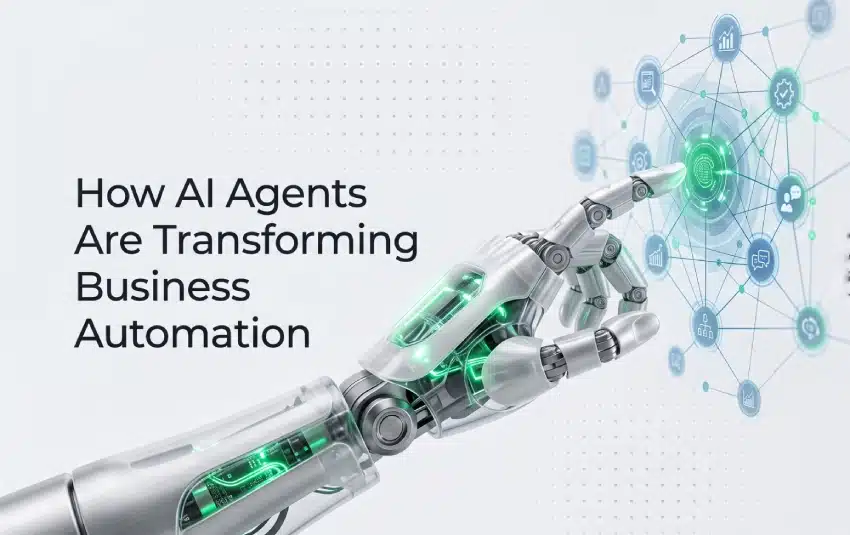
The scope of automation for business is expanding. By 2026, AI agents are becoming an essential technology that helps companies automate customer support, sales, internal processes, data, and repetitive workflows.
While the main function of simple chatbots is answering queries, an AI agent understands business objectives, interacts with business data, communicates with software systems, and performs complex workflows that have a set of preconditions and a human-in-the-loop.
If you want to improve efficiency in your company, reduce repetitive manual work, then the solution based on AI agents can help you.
What Are AI Agents?
An AI agent is an intelligent software system capable of understanding a task, making decisions and performing actions in order to achieve some business goal.
For instance, an AI agent receives a customer query, understands customer requirements, fetches information from a CRM, gives a relevant answer and forwards the conversation to a human member of the team if needed.
That’s what distinguishes AI agents from traditional automation when all possible actions must be predetermined.
Modern AI agents support workflows that run across websites, CRMs, ERPs, databases, APIs, communication platforms, and other business systems.
How AI Agents Influence Business Automation
Automation has proved to be very useful when it comes to dealing with repetitive and predictable tasks. There are lots of business processes that include communication, changes to information and decisions. Intelligent agents based on artificial intelligence could add this intelligence.
1. Automated Customer Support
Customer support representatives spend quite a lot of their time answering recurring questions related to products, services, orders and policies.
AI-based customer support agents are capable of giving instant responses, accessing authorized business information and handling requests 24/7.
Complex questions may be forwarded to human representatives with keeping the whole conversation context.
It will make possible for businesses to shorten response time and let support teams concentrate on important conversations with customers.
2. Enhanced Sales and Lead Qualification
AI agents could also be included into the sales process.
Sales AI agent could communicate with the visitors, ask qualifying questions, understand their needs, gather leads’ information and arrange appointments.
Businesses won’t need to let their leads wait for sales representative, engaging them immediately.
3. Automation of Repetitive Workflows
Companies often continue to rely on staff for repetitive administrative tasks like data entry, report generation, approval workflows and transferring data between systems.
An automated workflow agent can take several actions in various applications.
For instance, the agent may gather information, verify data, update CRM, produce a report and alert the responsible team.
The outcome is reduced manual labor and increased efficiency of the workflow.
4. Integration of AI into Business Systems
An AI agent becomes significantly more helpful if it is able to interact with the systems used by the company.
AI agents can be connected to:
- CRM systems
- ERP systems
- Databases
- Business APIs
- Communication systems
- Intranets
- Scheduling systems
- Customer service systems
Thus, AI will become a part of business processes rather than a separate chatbot.
Differences between AI Agents and Traditional Chatbots
Traditional chatbots normally rely on pre-programmed conversational flows and provide answers to certain questions.
In addition to the above, AI agents are able to use context, access to information, connections with tools and perform actions.
Such as:
Traditional chatbot:
“Our return policy is here.”
AI agent:
“You can return your order. I will initiate a return request and send all necessary information to our support department.”
The main difference is the transition from providing information to action execution.
Multi-Agent Systems: The Next Level
There are certain problems in business that cannot be solved by one AI agent.
Multi-agent systems overcome this by employing several specialized agents working together.
While one agent may deal with the client, another analyzes information, the third executes certain business process.
Coordination system allows you to organize such agents and assign tasks based on responsibilities of each of them.
Why Do Companies Require Secure AI Agents?
Apart from being a necessary factor in AI implementation, there are several issues regarding data security and permission management that should also be taken into account.
It is important to make sure that an AI agent has access only to certain data and can perform particular tasks.
When building a proper AI agent, one should think about the following aspects:
- Privacy of data
- Role-based access
- Secure integrations
- Audit logs
- Permission from people for sensitive actions
- Data security
- Performance evaluation
In terms of corporate use cases, AI should not have unlimited access to business systems.
How Malind Tech Creates AI Agent Solutions
Malind Tech creates customized AI agent solutions based on particular business needs rather than having just one chatbot solution.
Malind Tech AI agents can perform different tasks from conversational AI to voice agents, automation of customer support, sales, leads qualification, automation of workflow and integration across the stack and multiple agents.
It is possible to integrate AI agents with CRMs, ERPs, databases, APIs and other communication channels, so that they become a part of actual business process.
In case of need for any AI agent solution like customer support agent, sales assistant, voice or multi-agent workflow solution, the system can be created according to its needs.
Tasks that Companies Can Automate Using AI Agents
AI agents can help many different aspects of running a company, including:
- Customer service
- Prospect lead qualification
- Sales follow-ups
- Scheduling appointments
- Employees’ assistance
- Data processing
- Business reports
- Approval workflows
- Customer relationship management updates
- Document-related tasks
- Voice communication with customers
- Cross-platform business processes
The most appropriate approach is typically to begin with the routine and measurable process and then to gradually introduce AI automation.
The Future of AI-Based Business Automation
AI agents can transform the role of software from a mere storage of information to an instrument for assisting businesses with completing tasks.
As the AI agents get better at handling contexts, using tools and working across different applications, companies will be able to implement more intelligent and integrated processes.
Nevertheless, the successful deployment of AI requires not only selecting the right AI model, but also having the correct infrastructure and other components.
This is where custom-built AI agents can play a key role.
Make Your Workflows Smart Using Malind Tech
Using AI agents, companies can benefit from reducing repetitive tasks, providing customers with a better experience and creating an efficient system.
Malind Tech designs unique AI agent solutions tailored to your business workflows, existing technology and goals.
We can assist with developing AI agents for customer service and sales, voice agents, workflow automation and multi-agent systems.
Interested in automating AI agents in your business? Talk to Malind Tech about your AI automation needs.